Will AI Make You Jobless? The Honest Answer Is Yes and No
AI will eliminate some jobs, change most of them, and create new ones. What the data from the WEF and IMF actually says, which kinds of work are most exposed, and what individuals and businesses can do about it.
It's the question behind almost every conversation about AI, even the ones that start with something else: is this thing going to take my job?
The honest answer is yes and no. Anyone who tells you only one half is selling something. Here's both halves, with the numbers behind them.
The "yes" part
Some jobs are going away, and pretending otherwise doesn't help anyone.
The World Economic Forum's Future of Jobs Report 2025, based on a large survey of employers worldwide, expects 92 million jobs to be displaced worldwide by 2030 because of technology, economic shifts and other trends. AI is one of the biggest drivers. The roles shrinking fastest are the ones built around routine processing: data entry, clerical work, basic bookkeeping, simple customer service scripts.
The International Monetary Fund estimated in January 2024 that almost 40% of jobs worldwide are exposed to AI, rising to around 60% in advanced economies. Exposed doesn't mean eliminated, but the IMF was clear that some of those jobs will be replaced rather than helped.
If most of your working day is moving information from one place to another in a fixed way, AI is coming for that part of it. That's the uncomfortable truth.
The "no" part
The same WEF report expects 170 million new jobs to be created over the same period. That's a net gain of 78 million jobs, not a loss. The IMF's own analysis found that in advanced economies, roughly half of the AI-exposed jobs are expected to benefit from AI rather than be replaced by it.
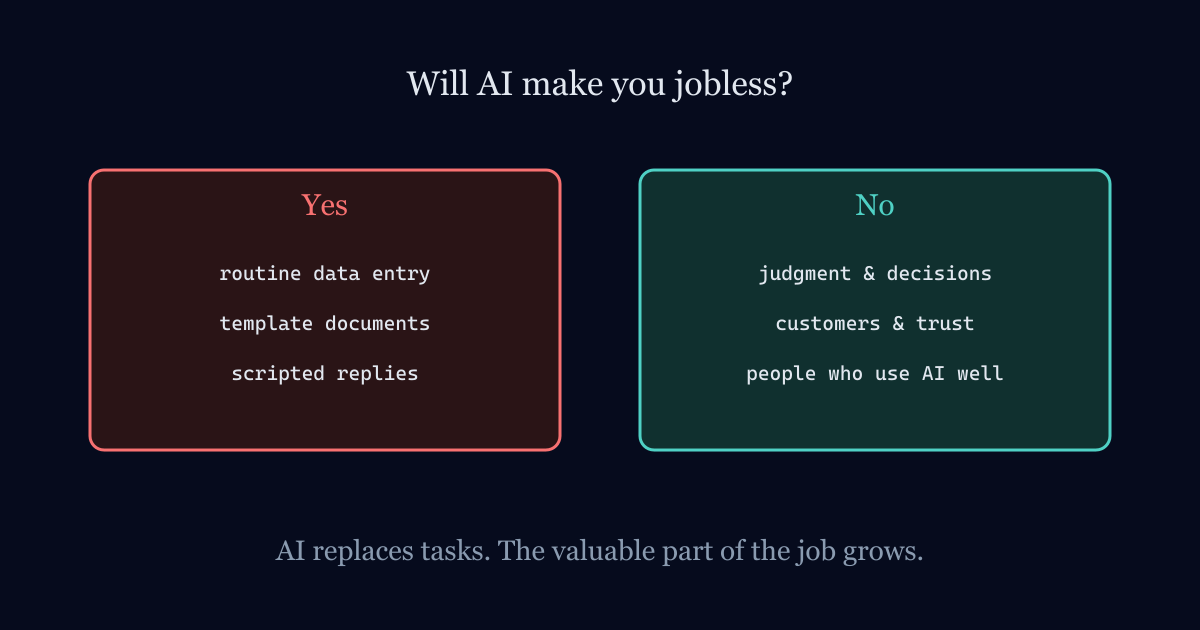
The more useful way to think about it is that AI replaces tasks, not whole jobs. An accountant's job is not one task. It's collecting documents, reconciling accounts, preparing returns, explaining numbers to the owner, spotting problems and advising on decisions. AI is very good at the first few and still weak at the last few. The job doesn't disappear. The mix changes, and the valuable part grows.
There's also a quieter pattern: companies that cut too deep come back. Klarna announced in 2024 that its AI assistant was doing the work of 700 customer service agents. By 2025, it was hiring people again, because customers wanted humans for the complicated cases and quality had slipped. AI took the routine volume; people were still needed for the rest.
So who should actually worry?
It's less about job titles and more about what you spend your day on.
More exposed: work that is repetitive, rule-based and judged only on volume. Copying data between systems, answering the same question for the hundredth time, producing documents from a template, checking things against a fixed list.
Less exposed: work that involves judgment under uncertainty, responsibility for outcomes, relationships and trust, physical skill in unpredictable settings, or deciding what the right question is in the first place.
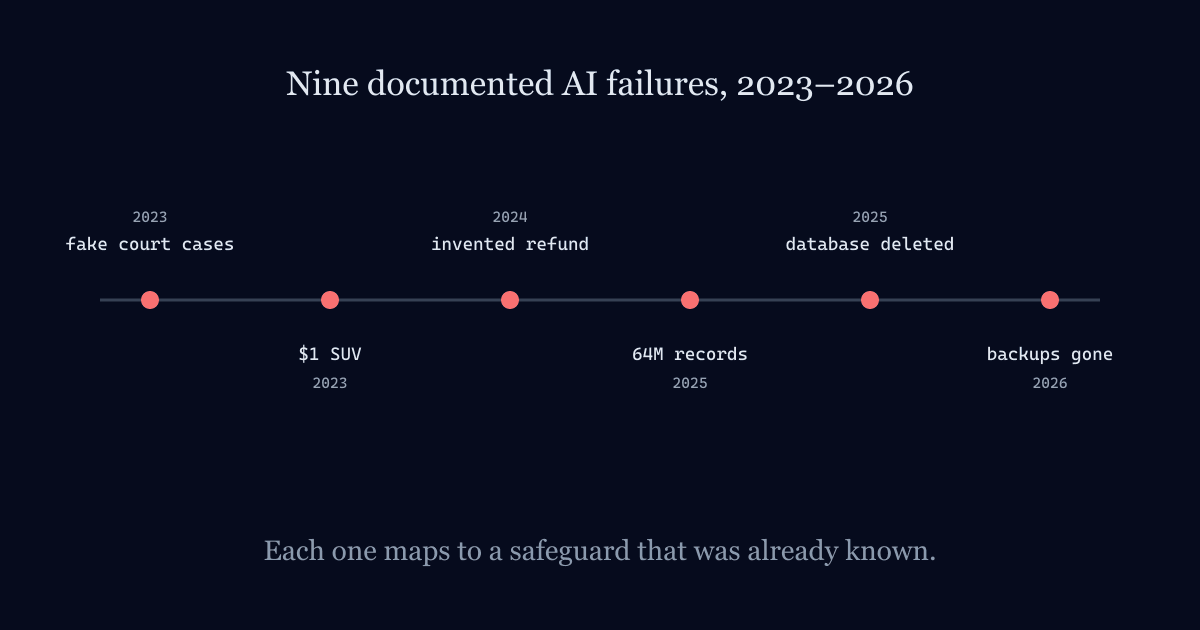
Most secure of all: people who know their field and know how to use AI well in it. An accountant who can supervise an AI doing reconciliations can handle three times the clients. A support lead who can design how an AI handles the routine tickets becomes more valuable, not less. Many of the well-known AI failures, from chatbots inventing policies to agents deleting databases, come down to nobody with that combination watching.
What individuals can do
- Learn to use the tools on your own work, now. Not in general, but on the specific tasks you do every week. The goal is to be the person who makes AI useful in your team.
- Move toward the judgment end of your job. If AI takes over the data entry, be the one who explains what the numbers mean.
- Understand the risks. Knowing where AI goes wrong, and where to draw the line, is a skill employers are short of.
- Own outcomes, not steps. People measured by results are much harder to replace than people measured by keystrokes.
What businesses can do
The businesses that handle this well treat AI as a way to take on more work with the same people, not just to cut headcount.
- Use AI on the routine, high-volume work, and move people toward customers, quality and decisions.
- Train your existing team to supervise and improve the AI. They know the work better than any outside hire.
- Keep humans on the complicated, sensitive and high-stakes cases, as Klarna learned.
- Be honest with staff about what's changing. Uncertainty does more damage to morale than the technology does.
That's also how we approach every project: AI that does the repetitive part, working alongside the people who own the result. It's how the assistant in Izma Office works, answering the lookup questions so finance staff can spend their time on the analysis. It's also how we build AI agents and knowledge bases for clients. If you're working out what AI should and shouldn't take over in your business, read where the real AI multiples come from next.
The short answer
Will AI make you jobless? If your whole job is a task a machine can now do faster, it may well change beyond recognition, and soon. For most people, AI will take over part of the job, raise the value of the rest, and create roles that don't exist yet. The people who come out ahead will be the ones who learned to work with it early.
Sources
- World Economic Forum: Future of Jobs Report 2025, 78 million net new jobs by 2030
- CNN Business: Nearly 40% of global employment could be disrupted by AI, IMF says
- Klarna: AI assistant handles two-thirds of customer service chats in its first month
- Forbes: Klarna reverses on AI, says customers like talking to people
Building AI that has to get it right?
We build AI agents and RAG knowledge bases with the guardrails these articles describe: sourced answers, scoped permissions, full audit trails.
AI Agents & RAG →