The Next Generation of Business Will Be Agentic — What That Actually Means
Every business wave gets a name. This one is 'agentic AI' — software that doesn't just show you information but answers questions, does the looking-up, and stays inside rules you set. Here is what it changes in practice, and what it doesn't.
Ten years ago the pitch was "move to the cloud." Five years ago it was "use AI." Right now it's "agentic AI," and like every wave before it, the phrase gets stretched over everything from genuine capability to a chat box someone bolted onto a search bar. This is about the real version: what actually changes when your business software stops being something you look at and starts being something you ask.
From dashboards to answers
The current model of business software is a dashboard. It shows you what happened, arranged into charts, and you do the last mile yourself — reading it, combining it with three other screens, drawing a conclusion, deciding.
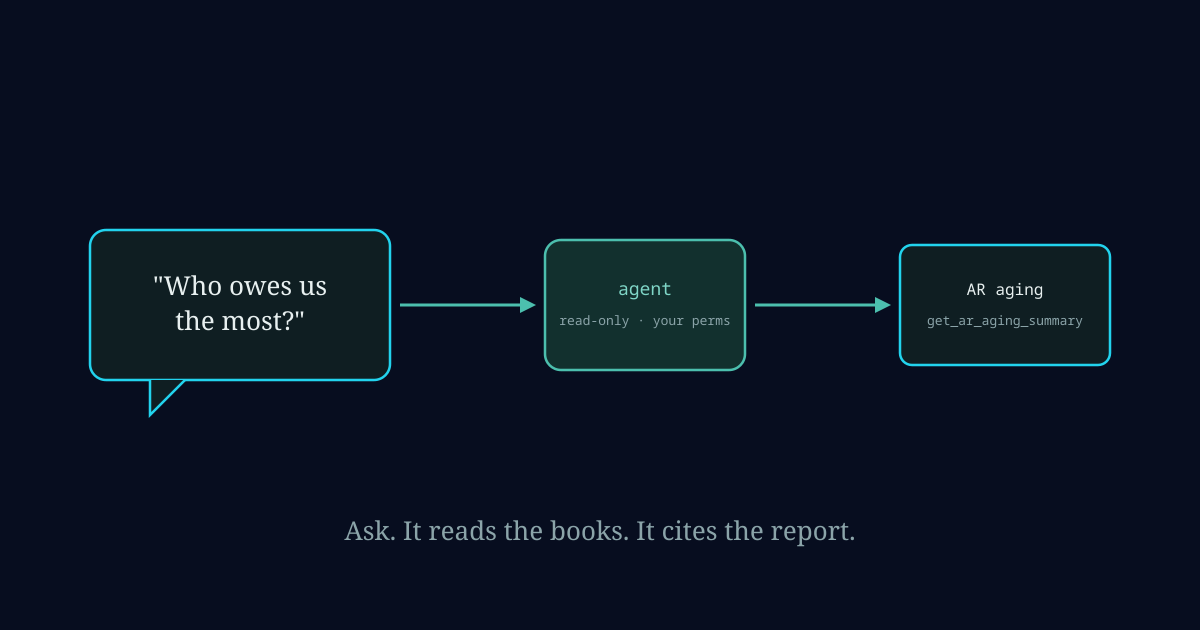
That last mile is exactly where agentic AI lands. And the difference isn't intelligence, really — a good dashboard is already "intelligent" in every sense a marketing team would use the word. The difference is the interface. An agent takes the question in the form you actually have it in your head:
"Who owes us the most right now, and are they buying more this month?"
...and does the looking-up itself. It finds the receivables, ranks them, cross-checks the recent orders, and comes back with names, figures, and — this part actually matters — where each figure came from.
You're still the one deciding. The agent just cut out the fifteen minutes of navigation and the two browser tabs that never quite agreed with each other.
What actually makes something "agentic"
Strip away the marketing and an agentic system really just has three properties worth caring about.
It takes goals instead of commands. "Find out who our slowest-paying customers are" is a goal — you didn't click through the reports yourself, the system figured out which filters and lookups would get there. It uses the same tools you do. A serious agent doesn't have some secret back door into your data; it calls the same queries and opens the same screens you would have opened by hand, which matters for a very practical reason — whatever you're allowed to see is exactly what it can show you, no more. And it stays inside a boundary. A useful agent behaves like a specialist: it answers questions about your business and declines what falls outside that, because a general-purpose chatbot that improvises about your cash position isn't an assistant. It's a liability with good grammar.
The trust problem nobody solves with a clever prompt
The honest objection to AI in business software has never really been about capability. It's trust. A model that can write a decent poem can also, with total confidence, get your receivables wrong.
This is why architecture beats prompting, and it's not a small distinction. An agent answering from its own memory of training data can simply invent a number. An agent wired so that every figure it states has to come from a real query against your live data can't invent one — the worst it can do is fail to find something, and the right behavior in that case is just to say so.
There's a practical test for any "AI" feature in business software: ask it a number, then ask it where the number came from. If it names a report you can actually open and drill into, it's reading your books. If it hedges, it's guessing.
What changes for a business that adopts this
Small things first, and they add up faster than expected. An owner stops waiting for month-end to ask a simple question — "how did we do this month" turns into a ten-second question instead of something you schedule a meeting around. Middle managers stop filing requests to the accounts team for lookups the accounts team also finds tedious to run. New hires get productive faster, because "just ask it" is a much shorter training manual than any navigation guide anyone's ever written.
The bigger shift is cultural, not technical. When getting an answer is cheap, people ask more questions — and businesses that ask more questions of their own data tend to make fewer decisions on vibes.
What doesn't change
Two things, on purpose. People still decide. An agent that's read the books can tell you exactly who owes the most. Whether to keep doing business with that customer is a judgment call with context no system holds, and it should stay that way. And records still matter — an agent is only as good as the ledger sitting underneath it. A business that records nothing has nothing for the agent to read. Agentic AI isn't a replacement for the unglamorous discipline of proper bookkeeping. If anything, it's the first thing that's made that discipline pay off every single day instead of only at year-end.
The near future, honestly
Most businesses won't go out and "adopt an AI." They'll adopt an assistant inside the system they already use, the same way nobody really "adopted search" — it just quietly became how finding things worked. The systems that win this shift will be the ones where the agent reads the real ledger, inherits the real permissions, and writes to the real audit trail.
The systems that lose will be the dashboards nobody opens anymore, sitting next to businesses that are still closing the books on the 8th, asking their software questions it was never built to answer.
If you want to see what an agent looks like when it's wired into the books this way rather than bolted on top, the product page shows the design and the documentation shows how it actually works underneath.
Building AI that has to get it right?
We build AI agents and RAG knowledge bases with the guardrails these articles describe: sourced answers, scoped permissions, full audit trails.
AI Agents & RAG →