Can AI Really 10x Your Business? Where the Multiples Actually Come From
5x and 10x gains from AI are real, but they happen on specific workflows, not whole businesses overnight. Here's where the big multiples come from, where they don't, and how to stack them into growth that shows up on the P&L.
"AI will 10x your business" is the kind of line that gets clicks and loses trust. It's not exactly false. It's just aimed at the wrong unit. The businesses seeing enormous gains from AI almost never got them from one big AI project. They found specific workflows where the gain is five, ten, sometimes a hundred times, and stacked them.
Understanding where those multiples live is the difference between an AI budget that pays for itself and one that produces a demo.
Multiples happen at the task level
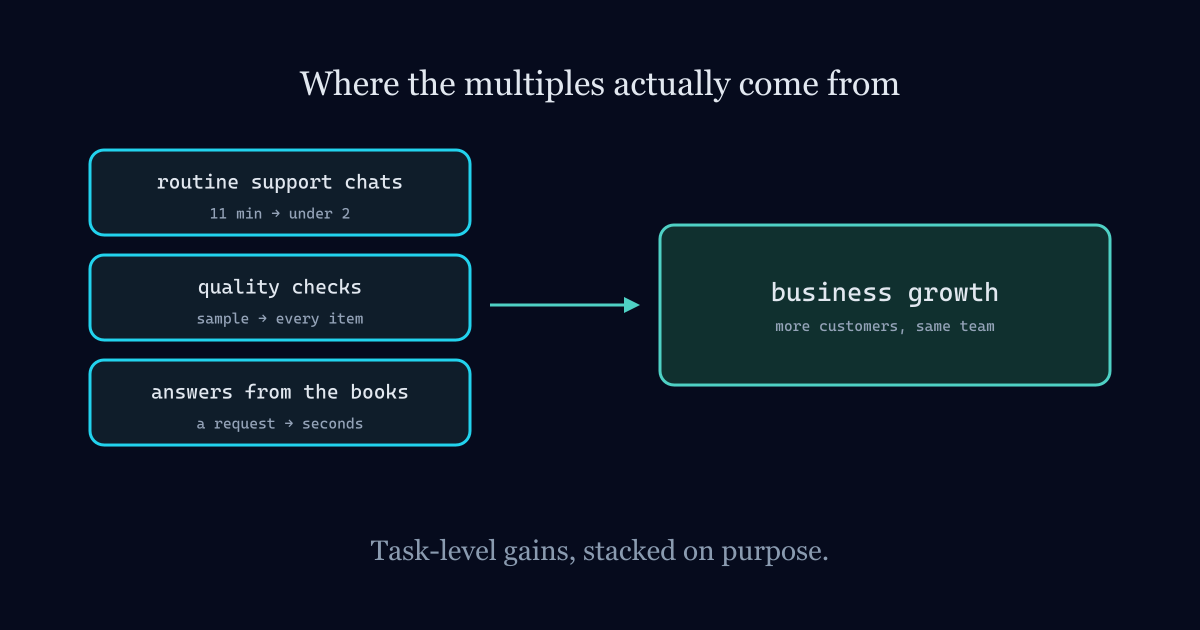
Take one of the best-documented examples. In February 2024, Klarna said its AI assistant had handled 2.3 million customer conversations in its first month, two-thirds of all its customer service chats. Klarna put that at the equivalent of 700 full-time agents, with issues resolved in under two minutes instead of eleven. That's more than a 5x gain in resolution time on that task, and Klarna estimated a $40 million profit improvement for the year.
Then, in 2025, Klarna publicly shifted back toward human agents. Its CEO said focusing too heavily on cost had lowered quality, and customers were promised they could always reach a person.
Both halves of that story are the lesson. The multiple was real, on routine high-volume queries. It didn't extend to the complicated, emotional or unusual cases, and pushing it there cost more than it saved.
Where the big multiples come from
Speed on repetitive, well-defined work. Tasks that take a person twenty minutes of looking things up and typing can take seconds when an AI with the right tools does the lookup. Examples are classifying documents, answering "where's my order," extracting fields from invoices, and drafting routine replies. This is where 5x to 20x gains in throughput are ordinary.
Answers that used to need a request. In most companies, "how much did we sell to this customer this year?" means asking finance and waiting. An assistant that queries the live books answers in seconds. The saving per question is small; the number of questions people start asking, and the decisions made on real numbers instead of guesses, is where it adds up. That's the thinking behind the assistant in Izma Office.
Capacity without hiring. A team of five that handles twice the volume because AI does the first pass hasn't cut costs. It has grown without a proportional rise in headcount, which is often the most valuable multiple of all for a growing company.
Work you couldn't afford before. Checking every item on a production line instead of a sample. Reviewing every contract instead of the big ones. Answering every customer at 3 a.m. in their own language. When the cost of a task drops by 10x, things that weren't worth doing become worth doing. Our Smart QC system inspects every garment on a line for exactly this reason.
New products built on your data. Businesses sitting on years of specialized data can turn it into something new: a fine-tuned model, a knowledge base clients pay to query, an assistant that knows their domain better than a general model ever will. That's growth, not efficiency, and it's where custom datasets and model training earn their keep.
Where the multiples don't show up
- Judgment-heavy work. Negotiation, complex complaints, strategy and anything where context matters more than speed. AI helps people prepare; it doesn't replace the judgment.
- Low-volume tasks. Automating something that happens twice a month rarely pays back the setup.
- Messy data. If the underlying records are wrong or scattered, AI makes bad answers faster. Fixing the data is often the first, unglamorous win.
- Processes nobody understands. You can't automate a workflow that lives in one person's head. Mapping it first usually uncovers savings before any AI is involved.
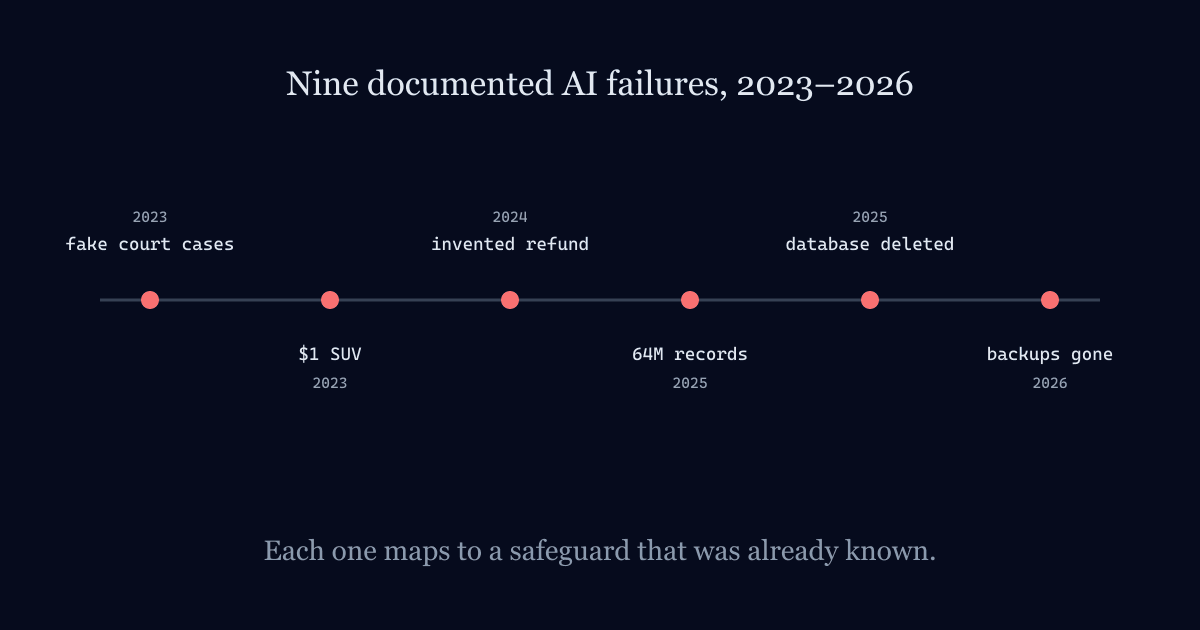
- Unsupervised customer-facing AI. Several of the incidents in 9 real AI failures started as an attempt to save time or money with a chatbot. The saving didn't survive the missing safeguards.
How the task-level gains add up to business growth
Individual multiples become business-level growth when they're chosen deliberately and stacked:
- Find the bottleneck. Where does work queue up, where do people wait for answers, what stops you taking on more customers? That's where a multiple matters.
- Measure the baseline. Minutes per task, tasks per person, days to close the books, defects escaping. Without a "before" number there's no "after."
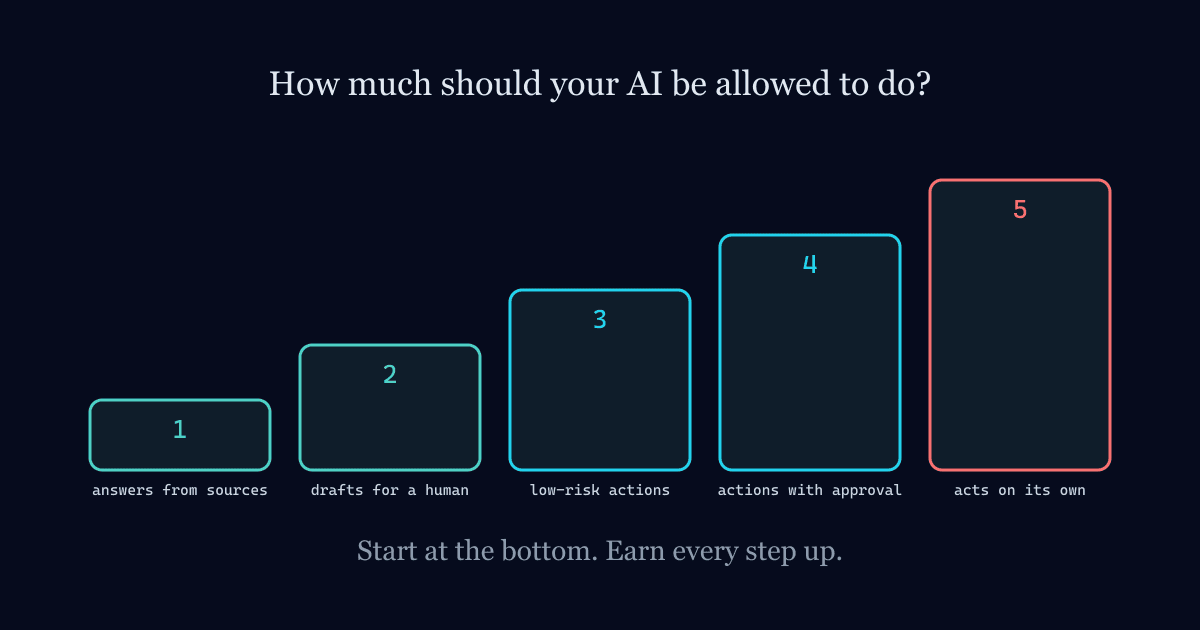
- Start at the safe end. Answers and drafts first, actions later. See where to draw the line.
- Build it properly. Tool calling over live data, answers that cite sources, permissions that hold. The difference is explained in raw data sharing vs tool calling.
- Keep people for the hard 20%. Route the unusual cases to humans, like Klarna ended up doing.
- Move to the next bottleneck. Then do it again.
Three workflows each running five times faster won't make the business fifteen times bigger. They can mean handling triple the customers with the same team, closing the books in a day instead of a week, and launching a service you couldn't staff before. That's what a real AI multiple looks like on the P&L.
Where to start
If you want to find the two or three workflows in your business where AI would pay off fastest, that's exactly the kind of engagement we take on, whether the answer turns out to be AI agents and a knowledge base, a fine-tuned model on your own data, or simply getting your back office onto one ledger first. We'll tell you which, even if it's the cheapest one.
Sources
Building AI that has to get it right?
We build AI agents and RAG knowledge bases with the guardrails these articles describe: sourced answers, scoped permissions, full audit trails.
AI Agents & RAG →