Accounting · VAT · Payroll · Inventory · AI Agent
Stop asking where the numbers are. Ask what they mean.
Izma Office runs the whole back office — accounting, sales, purchases, banking, inventory, payroll and approvals — on one double-entry ledger, with VAT returns, AIT/VDS certificates and treasury challans built for how Bangladesh files. And an AI agent that answers your business questions in plain language, from your own books.
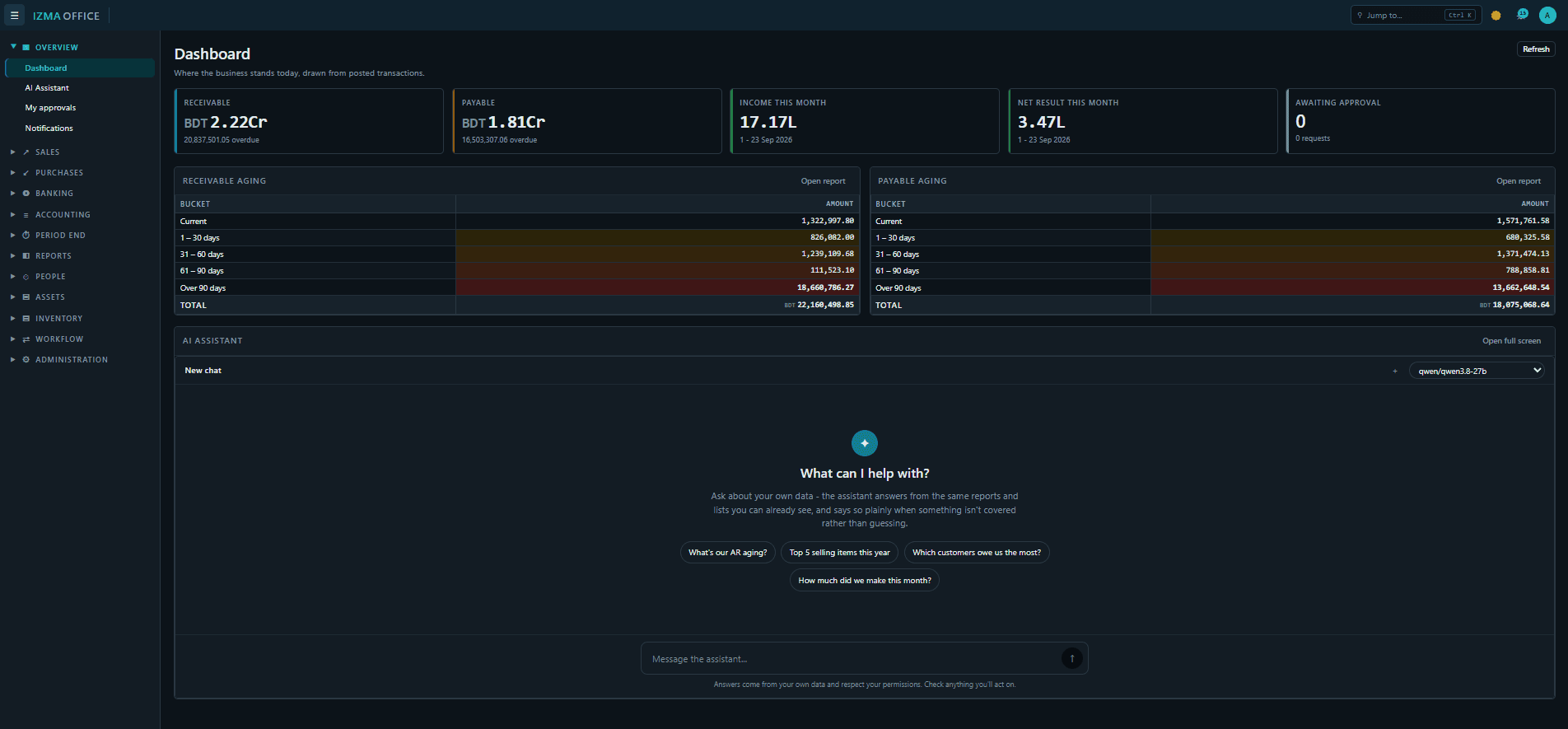
Built for trading, distribution, manufacturing and services companies in Bangladesh that have outgrown spreadsheets — with VAT, AIT/VDS, WPPF and gratuity handled out of the box.
The problems you know by name
Eight ways businesses lose days every month — and what fixes each one
If any of these is your month, this page was written for you. Each problem below is answered by a specific part of Izma Office, not a promise.
Month-end takes a week, and it's still wrong
Invoices in one file, the bank statement in another, the stock count in a notebook — and one person who knows how it fits, on leave.
Every invoice, bill, payment, payroll run and stock movement posts to the same double-entry ledger as it happens. There is no month-end assembly: the trial balance is always true, and every figure drills back to the journal entry behind it.
Nobody can answer 'how much did we actually make?' today
The honest answer is 'give me three days' — which means decisions that needed yesterday's numbers get made blind.
Reports compute live the moment you open them — no generate step, nothing to refresh. Post an invoice a minute ago and it is already in the income statement. Or just ask the AI agent.
VAT return time means rebuilding everything from scratch
Exporting to spreadsheets, cross-checking registers by hand, hoping the figures the treasury sees match the books.
The VAT return is already there, with the output and input tax registers sitting behind every figure — computed from the same posted documents the books read. AIT/VDS certificates and treasury challans come from the same records.
Who owes us — and how badly?
Aging lives in a spreadsheet someone updates when they remember. Chasing is a mood, not a process.
AR aging ranks customers worst first, collections turns it into a worklist with days late and contact details per invoice, and statements print from the same screen. Nothing is sent automatically — you decide who to chase.
Payroll is a late-night spreadsheet ritual
Attendance exports, unpaid leave, loan instalments and tax slabs reconciled by hand — and one typo reaches every payslip.
Payroll builds from salary structures, attendance, leave, loans and the current fiscal year's tax slabs, posts to the ledger when you finalize, and prints payslips. Attendance flows in from devices where they're installed.
Stock and accounts disagree
The warehouse says 40, the system says 53, and the cost of goods sold is a guess.
Stock is valued at weighted average and relieved to cost of goods sold on dispatch. Dispatches are recorded by the storekeeper against the invoice, adjustments post with a reason, and the reorder level flags what's running out.
Nobody knows who approved what
Approvals happen in hallways and WhatsApp. When something goes wrong, there is no trail and no owner.
Role-ordered approval chains route documents through named steps, with the full decision trail kept permanently. An inbox shows everything waiting on you. Maker–checker separation means the person who raises a document is not the one who posts it.
The books can't survive an audit
Corrected by overwriting, history lost, and the story of what actually happened nowhere to be found.
Posted documents are never edited or deleted — voids, reversals and credit notes cancel them visibly. Audit logging records who changed what and when, including every AI lookup. Close periods to stop backdated posting; the year close is guarded.
Product tour
The screens your team will actually use
Real screens from Izma Office, running on demo data. No mock-ups.
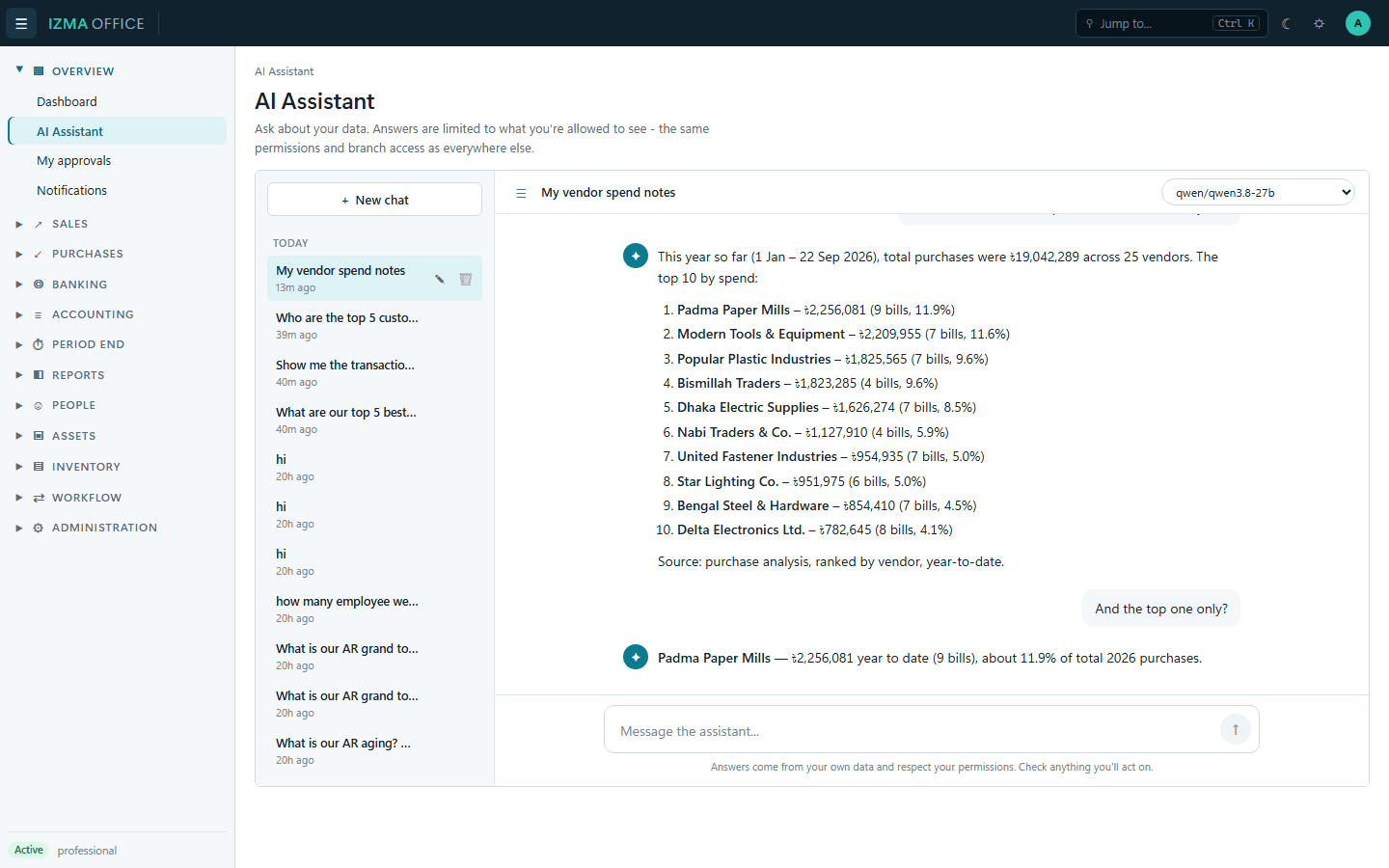
AI assistant that reads your books
Ask "who are our top vendors this year?" and get ranked figures with the report they came from.
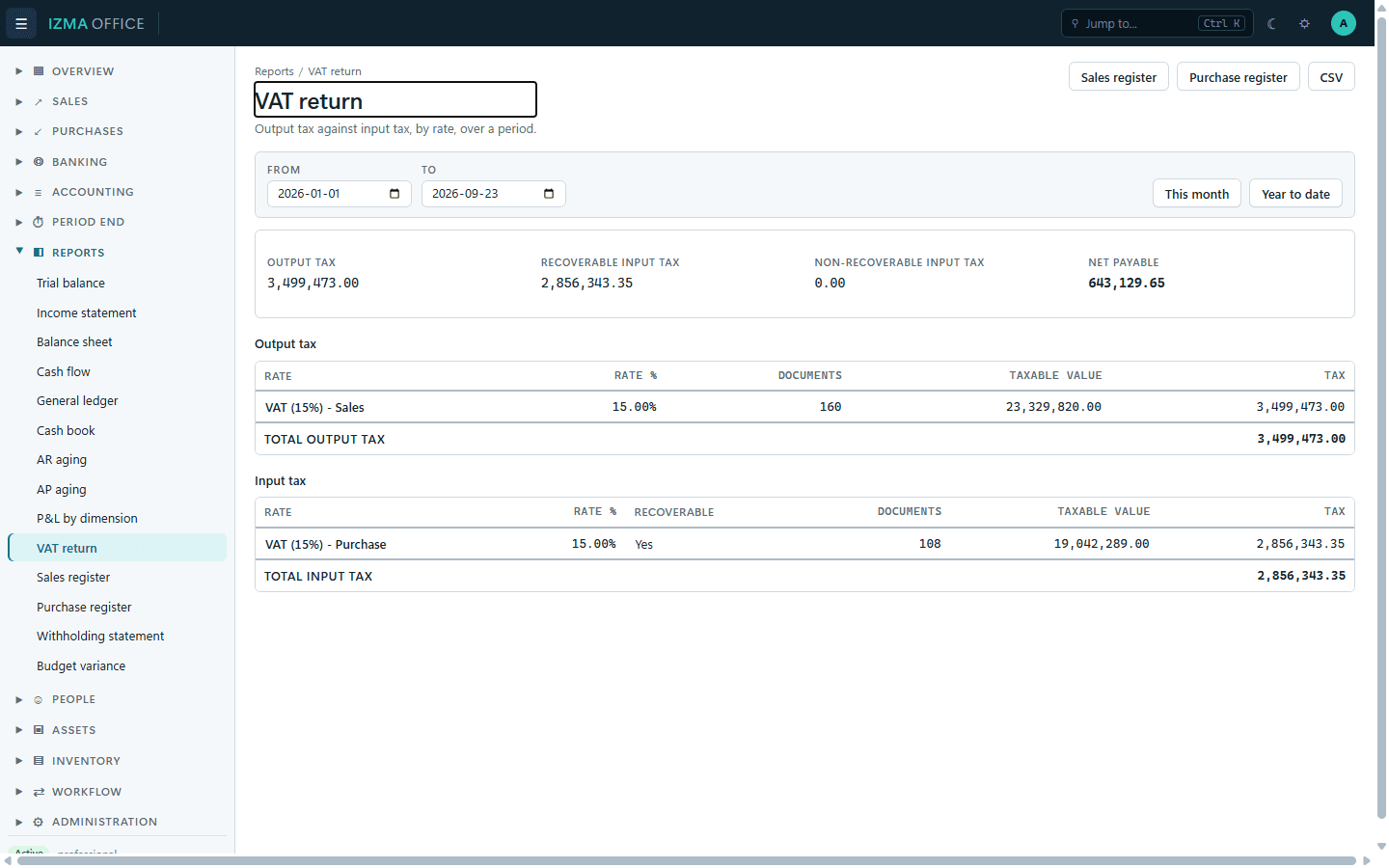
VAT return, computed live
Output tax against input tax by rate, with the sales and purchase registers one click away.
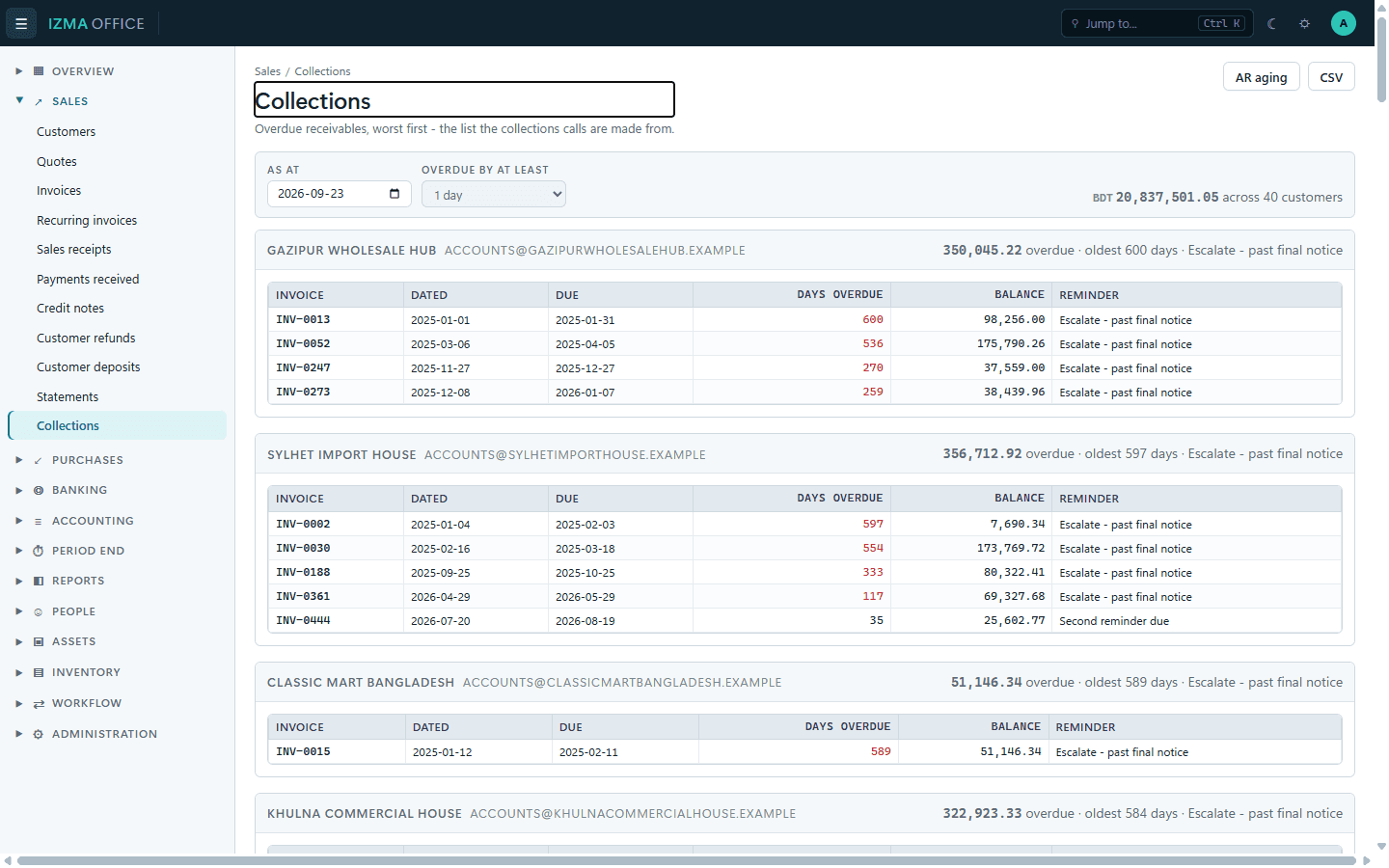
Collections worklist
Overdue customers worst first, with each invoice, days late and the reminder stage it has reached.
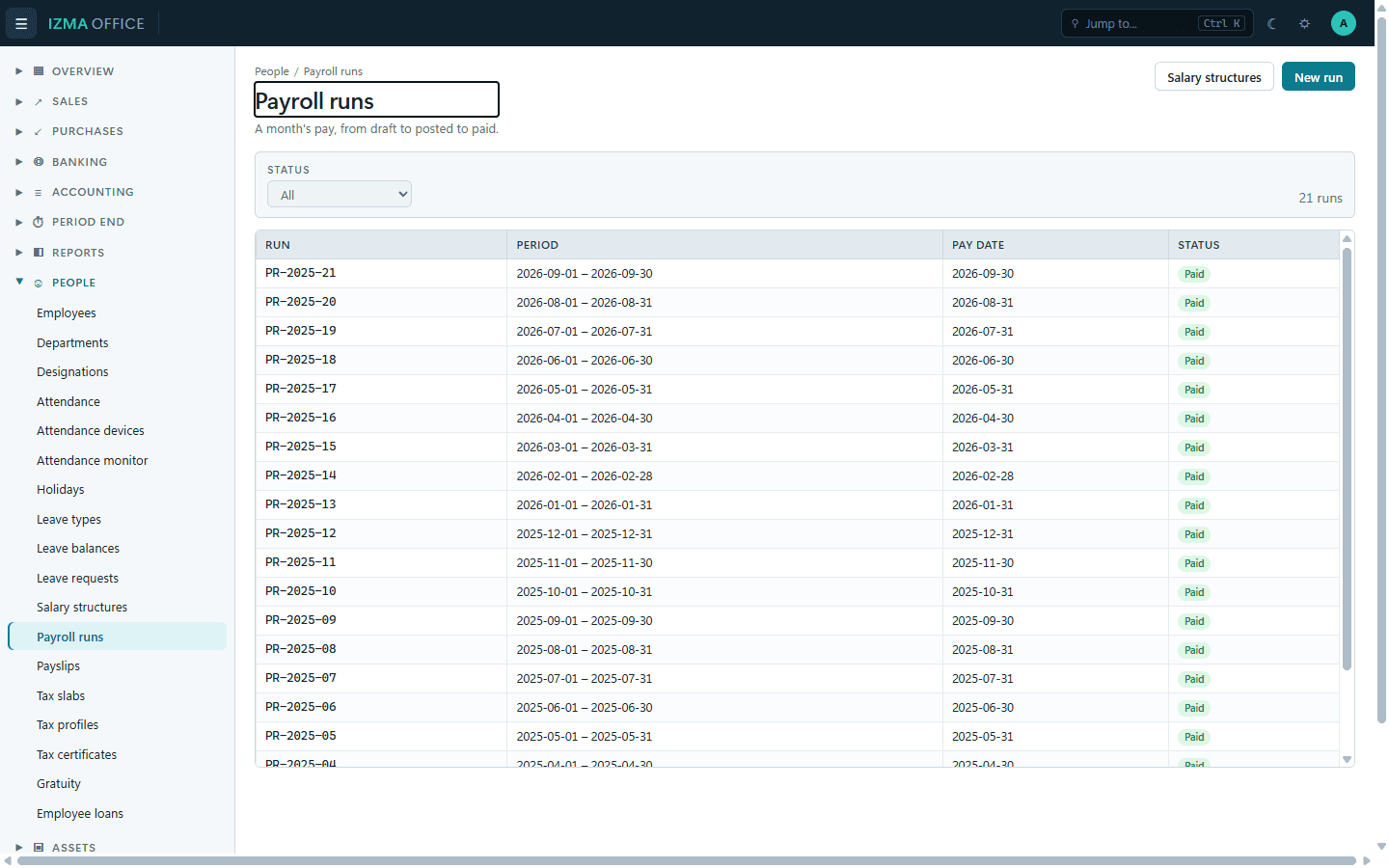
Payroll runs
A month's pay from draft to posted to paid, built from salary structures, attendance, loans and tax slabs.
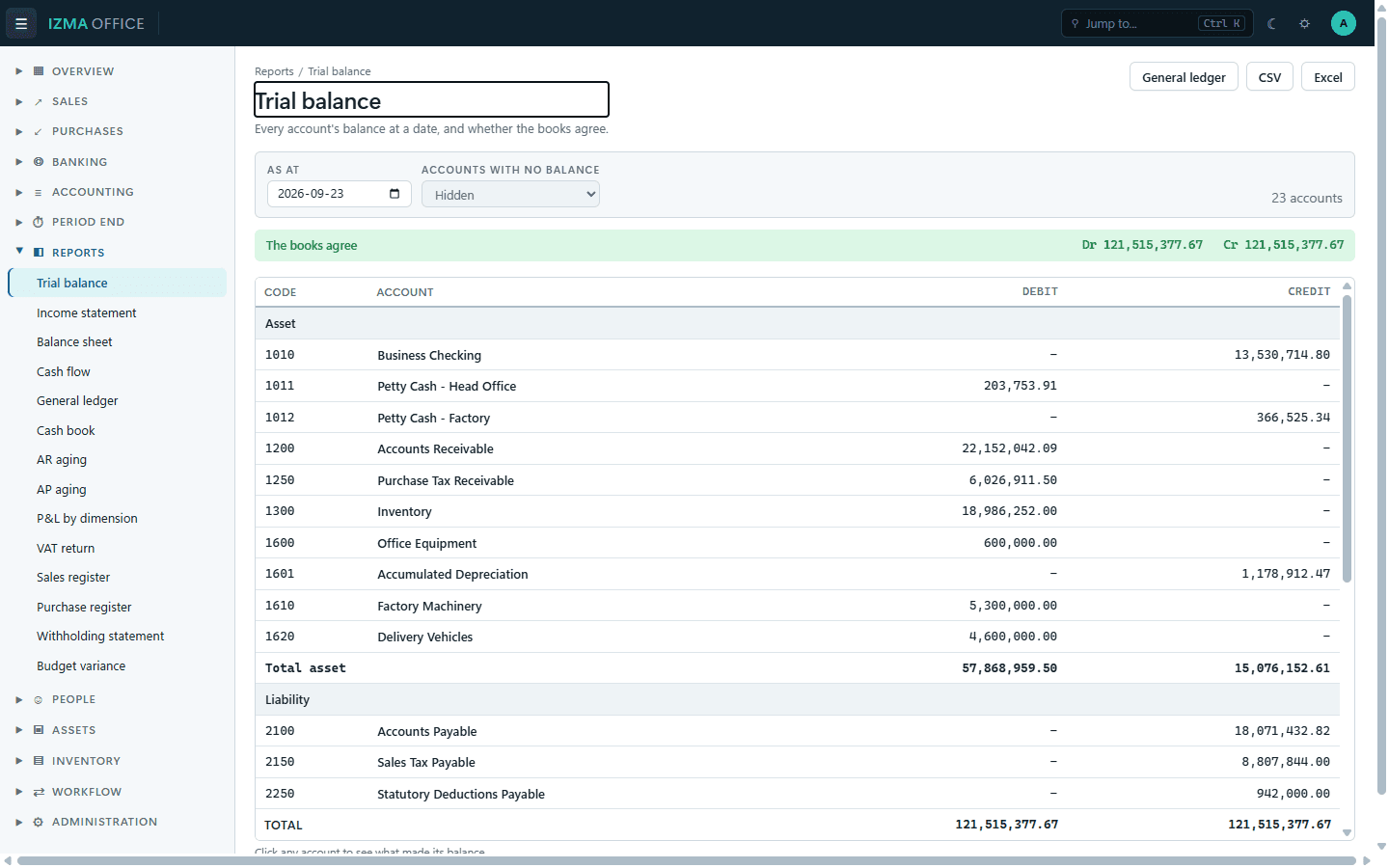
Trial balance, always true
Every figure drills back to the journal entry behind it. There's no month-end assembly step.
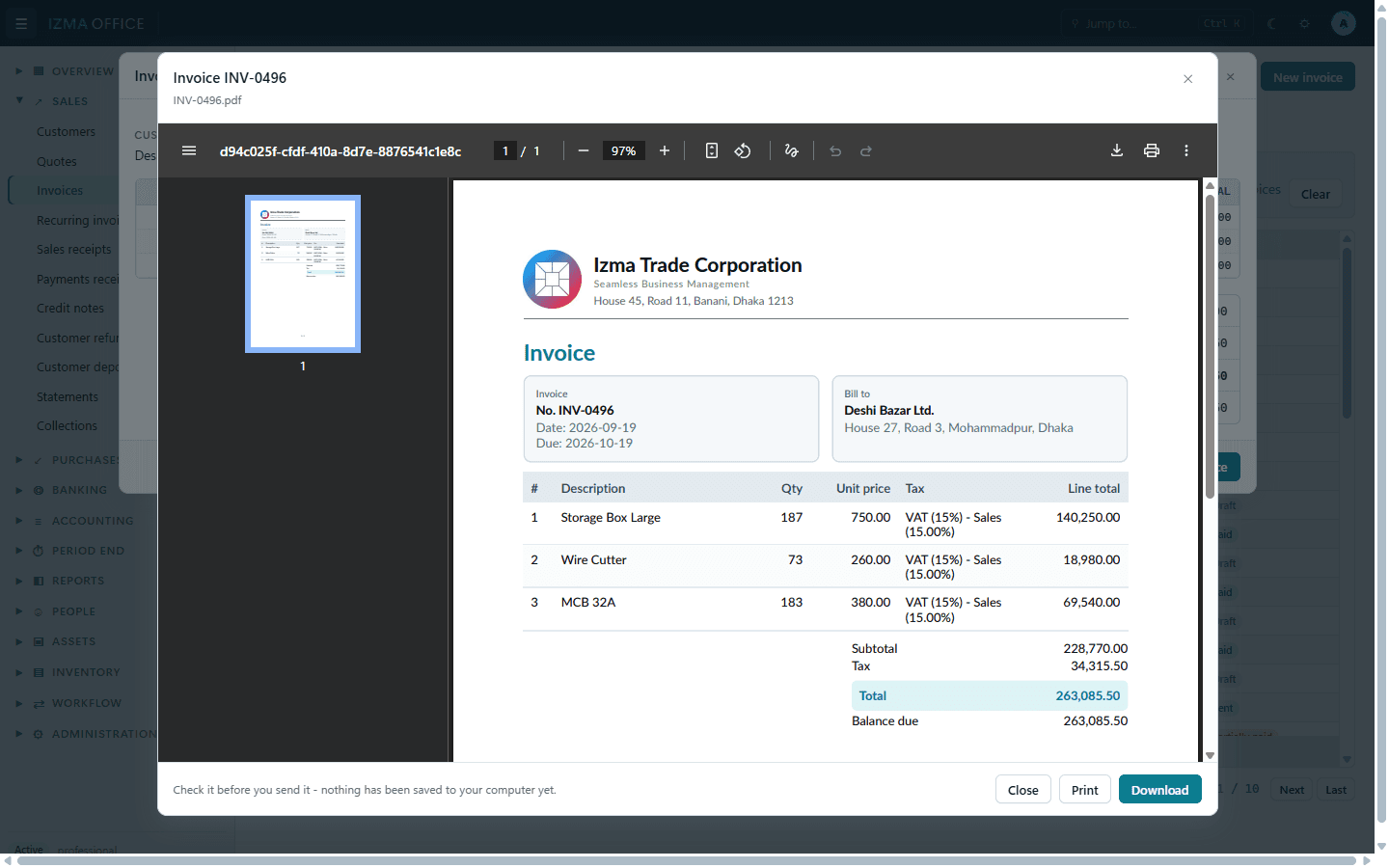
Documents on your letterhead
18 printable document types, previewed on screen before anything is downloaded or printed.
AI Agent
Ask your business a question. In plain language.
Every permitted user gets an assistant that reads the live books — not the internet. Connect your own OpenAI, Anthropic or OpenRouter key once, and anyone you allow can ask.
“Who owes us the most?”
Ranked from AR aging — real customers, real ৳ figures, days late.
“Top 5 selling items this year?”
From the sales analysis, with the report named.
“Show me Meghna Distribution House's history”
Their full statement, every charge and credit.
“Has payroll been run for September?”
It checks the payroll runs and answers — no guessing.
It cannot invent a number: every figure comes through the same queries the screens use, and it names the report each answer came from. It runs under your permissions — if you can't open payroll on screen, you can't ask your way into it either. Every lookup is written to the audit trail. And it is read-only by design: it answers; it never posts, edits or deletes anything.
Your key, your models
Connect OpenAI, Anthropic or OpenRouter once in Agent Setup. You choose which models staff may use. We provide the integration; usage is billed by your AI provider on your own account, so there's no markup and no lock-in.
Refuses, like a colleague would
Ambiguous name? It asks which customer. Outside the business? It says so. A general chatbot improvises; this one stays inside its job.
Remembered conversations
Past conversations are listed, named from what you asked, and can be renamed or deleted — the assistant's history works the way chat should.
Modules
Twelve modules. One hundred and four screens. Every one built.
Nothing below is a roadmap item or a stub — if it is in the menu, it works.
Accounting Core
Double-entry ledger, chart of accounts, journal entries with maker–checker, dimensions, multi-currency, IFRS 16 leases, deferred revenue.
Sales & Receivables
Quotes to invoices to payments, recurring invoices, credit notes, refunds, deposits, customer statements and collections.
Purchases & Payables
Requisitions, orders, receipts, bills, payments, debit notes, vendor advances and expenses — the full chain.
Cash & Bank
Bank accounts, transfers, cheques both directions with clearing status, statement reconciliation, petty cash with a custodian.
VAT & Withholding
VAT return with registers, AIT/VDS withholding certificates, treasury challans — statutory, out of the box.
Period End
Accounting periods, accruals, prepaid amortisation, FX revaluation, bad debt, WPPF appropriation and a guarded year close.
Reports
Trial balance, income statement, balance sheet, cash flow, ledgers, AR/AP aging, VAT return, budget variance — live, drillable, exportable.
People & Payroll
Employees, attendance from devices or by hand, leave, salary structures, payroll runs, payslips, tax slabs and certificates, gratuity, loans.
Assets & Inventory
Fixed assets with depreciation runs and disposal, stock valued at weighted average, dispatch and receive, adjustments with reasons.
Documents
Eighteen document types with your letterhead, a cell-level template designer, custom forms — previewed before anything prints.
Approvals & Workflow
Role-ordered approval chains with the full trail, plus an inbox of everything waiting on you.
AI Agent
Plain-language answers from the live books, under your permissions, audit-logged, read-only. Connect your own AI provider account; usage is billed by that provider.
A deployment that belongs only to you
Unlike typical cloud tools that pool every customer's data together, each Izma Office customer gets a fully isolated environment — dedicated application, dedicated PostgreSQL database, dedicated backups. Your financial data never shares a table with anyone else's. Not shared multi-tenant infrastructure — another company's rows are not there to be returned.
- ✓Dedicated database per company
- ✓89 permission codes — the server enforces what the screen hides
- ✓Maker–checker separation on every posting
- ✓Complete audit logging, including AI lookups
- ✓Two-factor authentication (TOTP)
- ✓Runs as Docker on your server or a cloud host you choose
App · Database · Backups
Fully separate stacks
True isolation — not shared multi-tenant tables
Getting started
Start from your real position, not a blank set of books
Go-live is a guided flow, not a leap of faith, and we're with you through it. After go-live we keep listening and improving the setup until it's paying off for you.
1 · Import
Customers, vendors, items and the chart of accounts come in from the spreadsheets you already keep.
2 · Open balances
Stage your position as at go-live. The flow checks it balances, then locks it.
3 · Shape it
Custom fields for what no standard box covers; document templates with your letterhead.
4 · Ask
Connect an AI provider key, invite your team, and ask the first question from the dashboard.
Questions people actually ask
Straight answers
If your question isn't here, ask us — or ask the AI agent during a walkthrough.
▸What is the best accounting software for a small business in Bangladesh?
It depends on whether local tax is built in. Most international tools treat VAT, AIT/VDS withholding and treasury challans as add-ons you configure yourself. Izma Office produces the VAT return with its registers, withholding certificates, challans, WPPF appropriation and payroll tax slabs natively — from the same ledger everything else posts to.
▸Can it generate VAT returns and AIT/VDS certificates automatically?
Yes. The VAT return is computed live from posted invoices and bills, with the output and input tax registers behind every figure. Tax withheld by you and from you produces its own certificate and period statement, and challans are recorded against the withholding they settle so deposits reconcile with liabilities.
▸How is the AI agent different from using ChatGPT for my accounts?
A general chatbot guesses; this one queries your live books through the same screens your team uses. Every figure it gives you comes from a real report and it names which one. It runs under your own permissions, every lookup is audit-logged, and it is read-only — it can answer about your business but never alter it.
▸Is my financial data shared with other companies?
No. Every company gets a fully isolated deployment — its own application, its own PostgreSQL database and its own storage. There is no shared database with a tenant column; another company's rows are not there to be returned.
▸Can we import our existing data and start mid-year?
Yes. Customers, vendors, items and the chart of accounts import from the spreadsheets you already keep, and a guided opening-balance flow stages your position as at go-live, checks it balances, then locks it — so day one begins from a balanced trial balance.
▸Can it run on our own server?
Yes. Izma Office ships as Docker containers on .NET 10 and PostgreSQL, and runs on your own server or a cloud host you choose, on Linux or Windows. A documented REST API with 423 endpoints sits under every screen for integrations.
▸Does it work for a business with several branches?
Yes. Users can be assigned to branches, and HR access is branch-scoped, so a manager for one branch sees that branch's people everywhere in the module without per-screen setup. Dimensions let you tag any line with a department, project or cost centre for a P&L by dimension.
▸What does it cost?
One plan, priced in BDT: ৳14,999 per month, no dollar conversion. The AI assistant integration is included; AI usage itself is billed by the provider you connect (OpenAI, Anthropic or OpenRouter) on your own account. Enterprise deployments with custom requirements are quoted individually.
Pricing
Honest pricing in BDT
No dollar conversions, no hidden implementation costs. AI usage is billed separately by your own AI provider.
Professional
Best ValueFor growing businesses that run on process.
- ✓Accounting core — ledger, invoicing, expenses
- ✓Cash & bank management
- ✓Financial reports (P&L, Balance Sheet, Trial Balance)
- ✓VAT return, AIT/VDS certificates & challans
- ✓Employees, attendance & payroll
- ✓Fixed assets & inventory
- ✓AI assistant integration (AI usage billed by your own provider)
- ✓Approval workflows & audit trail
- ✓Guided data migration & onboarding
- ✓Priority support
See it with your own books in it
We'll set up a working instance with your chart of accounts, your documents and your staff — then you ask it the question that made you look for a system.