How Businesses Lose Revenue to Poor Transparency — and Don't Even Know It
Most businesses don't bleed money in dramatic ways. They lose it quietly — in receivables nobody chased, discounts nobody claimed, and decisions made on numbers nobody trusted. A look at where the money actually goes.
No business ever writes a line item for the money it lost to not knowing things. There's no expense row for the customer who drifted 90 days overdue because nobody happened to check the aging list that week, or the supplier discount that expired while the bill sat unrecorded in a drawer. That's what makes poor transparency such an expensive habit: the losses never announce themselves. Nobody gets a receipt.
Here's where the money usually goes, one leak at a time.
The receivables nobody chased
Every business has customers who pay late, and most owners write this off as the cost of selling on credit. It usually isn't. The real cost is the gap between a late payer who's managed and one who's forgotten.
A managed late payer gets a call on day 5, a statement on day 15, a hold on new orders at day 30. A forgotten one sits in a spreadsheet that gets printed once a month, if the spreadsheet was even updated that month. Between those two treatments is often the difference between a 40-day collection cycle and a 90-day one — on the same customer, under the same contract.
The mechanics of forgetting are almost boring: the aging report lives with the accountant, the relationship lives with the sales team, and nobody's job description says "be the bridge between them." By the time the annual accounts show that one customer ate a fifth of the year's profit in unpaid balance, the damage in that relationship already happened, at the salesperson's discretion, against a clock nobody was watching.
What actually stops this is boring too: an aging report that's always current, ranked worst first, with the specific invoices and the right contact on the same screen. "Who should I chase today" needs to be a lookup, not a small research project.
The discounts and penalties that cancel each other out
Payables are the mirror image of the same problem. Supplier terms exist for a reason — pay in 15 days and take 2% off, or pay in 45 and accept the full price. When dues live in a drawer and a spreadsheet, payment runs happen in the order bills were found, not the order they were owed.
Ask most businesses what percentage of available early-payment discounts they actually captured last year, and you'll get a shrug. Ask what they paid in late fees and you'll get a smaller shrug. Both numbers look small on their own. Added up over a year, they're a real chunk of margin, and both are pure process losses — recoverable without selling a single extra unit.
The decisions made on stale numbers
A business working from a week-old view of itself makes a specific, expensive kind of mistake: the one that looked perfectly reasonable given the data on hand at the time.
Extending credit to a customer whose true outstanding balance was already too high. Accepting a big order without checking whether it would starve a more profitable one of stock. Discounting to hit a monthly number that had, in fact, already been hit a week earlier. Missing the window to hold prices because the margin erosion was sitting right there in the books three weeks before it showed up in the bank balance.
None of these look like losses in the moment. They look like normal decisions made by reasonable people. The loss only shows up later, wearing a different costume — a bad quarter, a write-off, "a year where the market was tough."
The private-spreadsheet economy
The most expensive symptom shows up last, because it's the one that compounds all the others: when the official numbers are slow, every department quietly starts keeping its own.
Sales keeps a receivables list. Procurement keeps a dues list. The warehouse keeps a stock list that doesn't agree with the accounts department's stock list. Each one is accurate on the day it's made and wrong every day after that. Decisions get made by cross-referencing lists that disagree with each other, and every disagreement turns into a meeting.
The end state is an organization with five versions of the truth and no referee. It's not that anyone is being dishonest with their spreadsheet. It's that nobody can afford to sit around waiting for the official version, so the official version slowly stops being the thing people actually use.
Transparency is an architecture, not a virtue
"Be more transparent" isn't advice a business can act on. The real question is what has to be true about the system underneath for transparency to show up for free, without anyone having to try.
In practice, three things:
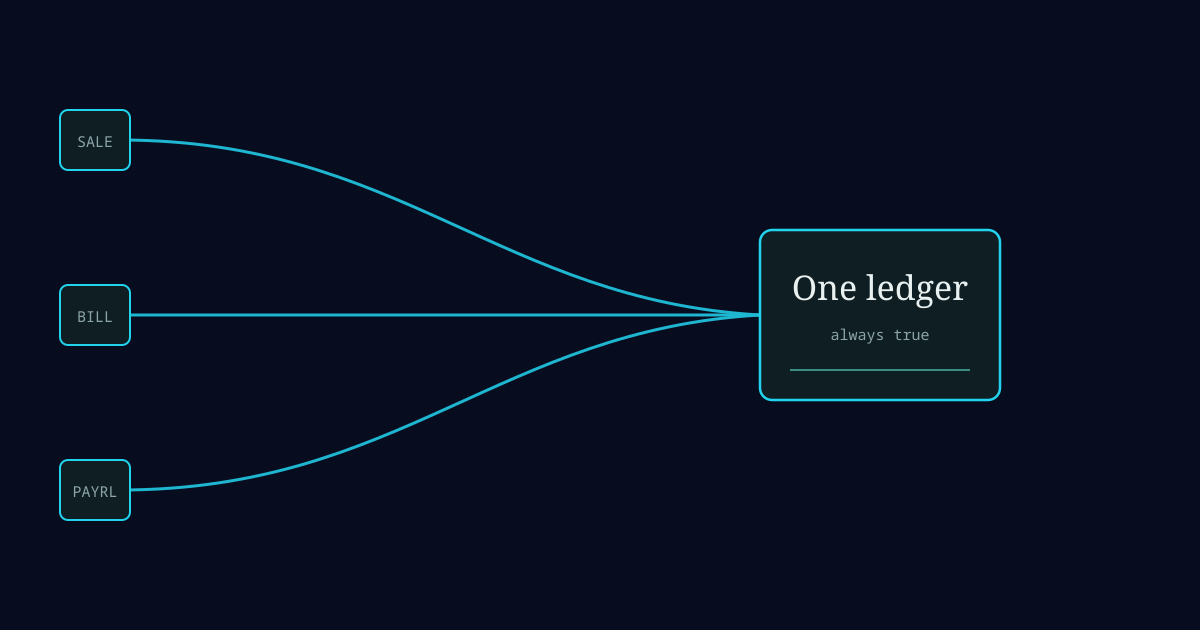
One recording point. Every invoice, bill, payment, dispatch and adjustment lands in the same ledger as it happens, not on paper or in a WhatsApp thread that the ledger has to catch up with later. Reports that are derived, not assembled by hand. If the aging report, the cash book and the stock valuation all compute live from that one ledger, they can't drift from it, and nobody has to babysit them into agreeing. And a correction path you can actually see: mistakes get reversed openly, leaving a trail, which is what lets people trust the numbers enough to stop keeping private ones of their own.
Get those three right and transparency stops being something you have to manage. It's just what the system does on an ordinary Tuesday afternoon.
One question worth asking this week
Ask whoever maintains the receivables list: if a customer called right now and asked for their exact outstanding balance, how long would it take to get them an accurate answer?
If the answer is "about a minute," you're fine. If the word "spreadsheet" comes up, you've just found your first leak.
The guides for collections, statements, payables and everything else mentioned here live in the Izma Office documentation, if you want to see how the mechanics actually work.
Still closing the books by hand?
Izma Office puts accounting, VAT, payroll and inventory on one ledger, with an AI assistant that answers from your live books.
See Izma Office →