The 8th of the Month: What a Week-Long Month-End Close Really Costs You
If your books close a week late every month, you are not just behind on paperwork — you are making every big decision of the month on numbers nobody has checked. Here is where the week actually goes, and what it costs.
Ask the owner of a mid-sized trading business when their books were last fully closed, and you'll often get a pause. Not because they don't know — because the answer is a little embarrassing. The month ended on the 30th. It's now the 8th, and the accountant is still reconciling the bank statement against a folder of invoices.
Nothing dramatic happens on any single one of those eight days, which is exactly why the cost stays invisible. Nobody writes a cheque labeled "slow close." The money leaks out through ten small decisions, all made about a week too late.
Where the week actually goes
Sit with an accountant during a close and the week breaks down into a fairly predictable list.
Two days go to hunting documents. The supplier sent the bill over WhatsApp. The delivery challan is still in the van. A customer paid into the wrong bank account and nobody noted which invoice it was meant to settle. Before any actual accounting can happen, someone has to play archaeologist first.
Another two days go to matching things that, in a better system, would match themselves. Stock in versus stock sold. Bank statement versus recorded payments. Sales register versus what was actually invoiced. Every mismatch turns into a small investigation, and there are always mismatches, because the sale got recorded in one place and the dispatch happened in another, weeks apart.
Two more days go to VAT — exporting to a spreadsheet, rebuilding the output and input tax totals by hand, cross-checking registers because the software doesn't produce them natively, or because there's no software at all, just a spreadsheet that's seen better days.
Whatever's left is rework. Something got entered twice. Something got entered under the wrong customer. Something got entered, then posted, and now un-posting it is a bigger job than the original mistake.
What the delay actually costs
The close itself is work that had to happen eventually, so the real cost isn't the week — it's the gap between when the numbers existed and when anyone actually trusted them.
Credit decisions get made blind. A customer asks for a bigger order and a longer term, and the right answer depends on what they currently owe and how late they really are. With books that close on the 8th, whoever's answering that question is working from memory, or from a receivables list that's already a week stale. Say yes too often and the bad debt shows up next quarter as a surprise nobody saw coming, even though it was visible weeks earlier.
Early payment discounts get missed and late penalties get paid, often in the same month. Without a live view of what's owed and when, payables get settled in the order they were noticed, not the order they were due. A supplier discount for early payment quietly runs out. Meanwhile a bill that sat in a drawer surfaces after its due date has already passed.
Then there are the cash surprises — the business is profitable on paper and still can't explain why the bank balance dropped. That question should take about a minute to answer from a cash book. When the cash book is a week behind, the answer arrives by feeling instead.
And underneath all of it: nobody trusts the official numbers, so everyone keeps their own. Sales runs its own receivables list, procurement runs its own dues list, the owner keeps a mental tally. Now the business is running three books that disagree with each other, and reconciling them has quietly become somebody's second job.
Why the week exists in the first place
It's worth being precise about the cause here, because the usual explanation — "we just need a better accountant" — is almost always wrong.
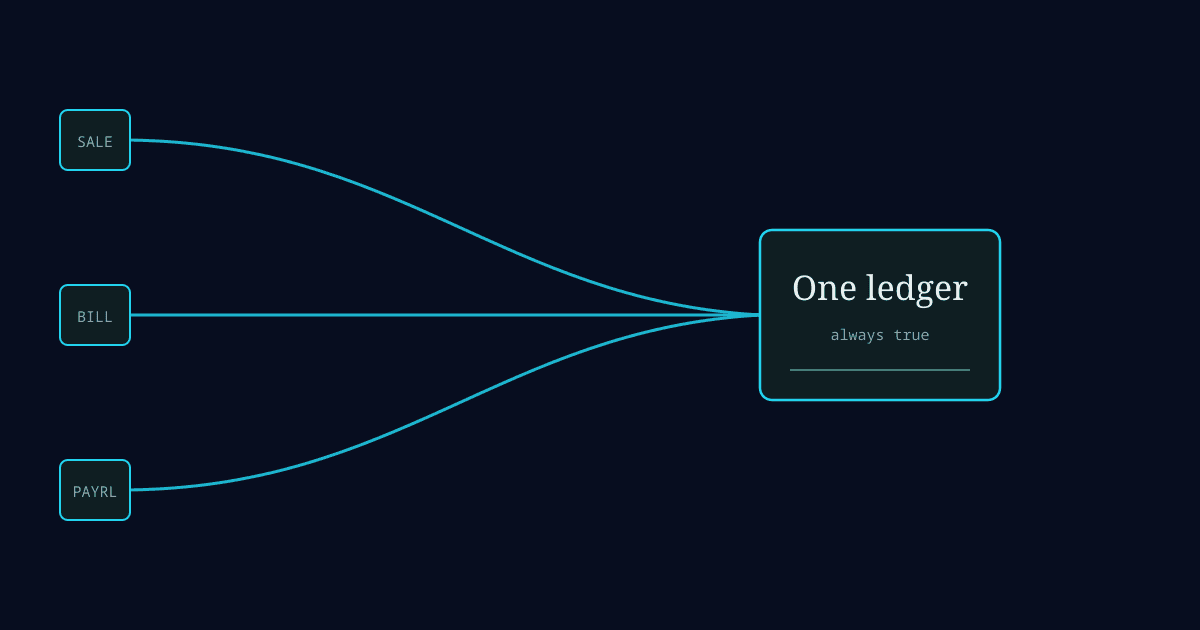
The week exists because recording and reconciling are treated as two separate jobs. The sale happened on the 12th, but it entered the accounting system, if there is one, on the 19th, off a pile of paper. The dispatch happened on the 13th, the stock movement got noted on the 14th, and neither touched the books until close week. Every figure arrives late, and every late figure then has to be matched against every other late figure by hand.
A week-long close isn't a discipline problem. It's an architecture problem. If every invoice, bill, payment, dispatch and payroll run posted to the same ledger the moment it happened, there would be nothing left to "close" — the trial balance would simply already be true, on the 8th and every other day of the month.
What "closed every day" actually looks like
Businesses that run this way share a few habits. The sale, the dispatch and the payment get recorded as separate events, right when they happen, by whoever did them, and the system does the matching instead of a person. The VAT return is computed straight from the posted invoices and bills, registers and all, instead of getting rebuilt by hand each month. Stock, receivables and payables stay current all the time, so collections and reordering run on live numbers rather than close-week printouts. And correcting a mistake means reversing it out in the open, never quietly editing it — which is exactly what lets an auditor actually trust the books.
None of this needs a bigger accounts team. It just needs the recording to happen where the work happens, into one ledger, instead of onto paper that a ledger has to catch up with weeks later.
The honest first step
Before you buy anything, measure the gap yourself. Pick this month and write down three dates: when the month ended, when the books actually closed, and how many decisions happened in between on numbers that hadn't been checked yet. Multiply that gap by twelve months. That's roughly what a live system is worth to you — and it's a number worth having before anyone shows you a demo.
If you do end up evaluating systems, ask each one the same question: if I post an invoice right now, is the trial balance different immediately, and can I click from the report back to the entry behind it? If the answer involves a sync, an import, or an overnight job, the 8th of the month is still waiting for you on the other side of that answer.
This is part of a running series on keeping a back office current every day — the step-by-step guides for invoicing, reconciliation, VAT and payroll live in the Izma Office documentation.
Still closing the books by hand?
Izma Office puts accounting, VAT, payroll and inventory on one ledger, with an AI assistant that answers from your live books.
See Izma Office →